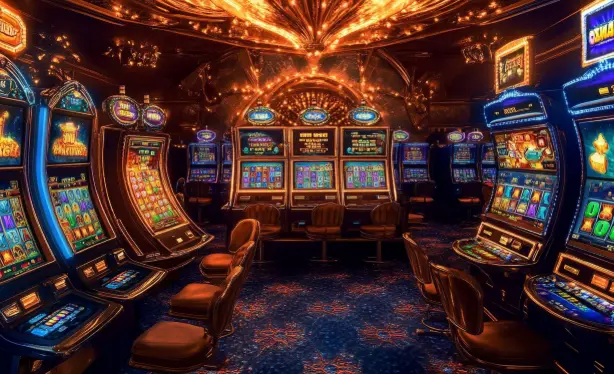
The Rise of Decentraland Casino Metaverse: A New Frontier in Digital Wagering
The convergence of blockchain technology and immersive virtual environments has birthed an unprecedented paradigm shift in online gambling. Decentraland Casino Metaverse represents the apex of this evolution, offering a decentralized, user-owned ecosystem where provably fair gaming meets boundless virtual real estate. 🎰 Unlike traditional online casinos constrained by centralized servers, this virtual guide navigates you through a permissionless landscape where smart contracts autonomously govern payouts, eliminating counterparty risk and human intervention. The architectural backbone relies on Ethereum's ERC-721 and ERC-1155 standards, enabling true digital asset ownership of virtual parcels, casino chips, and wearables that players can trade on secondary markets.

Navigating the Virtual Guide: Core Mechanics and Tokenomics
Understanding the operational mechanics of Decentraland Casino Metaverse requires fluency in its native utility token, MANA, alongside wrapped ETH for gas optimization. The virtual guide delineates how players connect via non-custodial wallets such as MetaMask, interacting with casino smart contracts deployed on Polygon Layer-2 for sub-second finality and negligible transaction fees. Liquidity pools incentivize staking, while non-fungible tokens represent VIP access passes or high-roller suites. The economic model diverges radically from legacy iGaming operators—revenue flows directly to decentralized autonomous organizations (DAOs), where token holders vote on house edge parameters, game additions, and promotional treasury allocations. This governance layer ensures alignment between platform sustainability and player interests, a feat unimaginable in conventional casino structures. 🎲

Provably Fair Algorithms and Immersive Game Diversity
At the heart of every wager lies cryptographic verification. Decentraland Casino Metaverse employs commit-reveal schemes and zero-knowledge proofs to guarantee game integrity, allowing players to audit randomness seeds pre- and post-bet. The virtual guide catalogs a spectrum of experiences: from blockchain-based blackjack and roulette to skill-centric poker tournaments hosted in custom-built estates. Virtual reality integration through WebXR transports users into hyper-realistic lounges where avatars socialize, negotiate side bets, and attend exclusive NFT-gated events. Cross-chain interoperability further expands reach, with bridges facilitating asset transfers from Binance Smart Chain and Solana, thereby aggregating liquidity and player bases into a unified metaverse gambling hub.
Regulatory Ambiguity, Responsible Play, and Future Trajectories
Despite its technological sophistication, the legal perimeter surrounding Decentraland Casino Metaverse remains fragmented across jurisdictions. The virtual guide advises rigorous due diligence: players must ascertain local statutes regarding cryptocurrency wagering, anti-money laundering (AML) compliance, and know-your-customer (KYC) thresholds enforced by certain virtual land operators. Decentralized identity solutions like verifiable credentials aim to reconcile pseudonymity with regulatory expectations, though adoption is nascent. Responsible gambling tools—self-imposed limits, cool-off periods, and on-chain analytics—are emerging as community-driven standards. As layer-3 scaling and account abstraction mature, the friction between regulatory oversight and decentralized ethos will likely catalyze hybrid models, where licensed entities operate compliant storefronts within permissionless protocols. 🃏